🇬🇧 Driving in the United Kingdom
Rules of the road
The Highway Code
The Highway Code is the rulebook for everyone on Great Britain's roads, with a matching version for Northern Ireland. Rules worded with "MUST" or "MUST NOT" are legal requirements. The others are advice, but ignoring them can still be used against you in court. The driving theory test is based on it.
Hierarchy of road users
Since 2022, the Code says that the people who can do the most harm (drivers of large vehicles, then cars) have the most responsibility to look out for others. In practice:
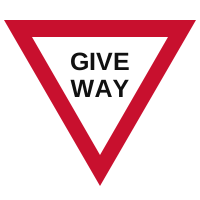
- At a junction, give way to pedestrians who are crossing or waiting to cross the road you're turning into.
- Give way to pedestrians on a zebra crossing, and to pedestrians and cyclists on a parallel crossing.
- Leave at least 1.5 metres when overtaking a cyclist at up to 30 mph, and more at higher speeds.
National speed limits (cars and motorcycles)
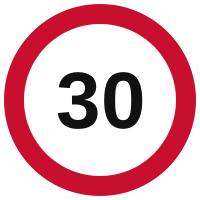
- Built-up areas (roads with street lights): 30 mph. In Wales, the default on most of these roads has been 20 mph since September 2023.
- Single carriageways: 60 mph.
- Dual carriageways and motorways: 70 mph.
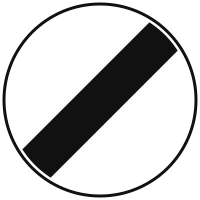
Lower limits apply when towing and for vans, buses and lorries. A white circle with a black diagonal stripe means the national speed limit for that type of road applies.
Roundabouts
Go round roundabouts clockwise and give way to traffic coming from your right, unless road markings or signals say otherwise. Signal left as you pass the exit before the one you want.
Motorways
- Keep to the left-hand lane unless you're overtaking, and overtake on the right. Don't overtake on the left (undertake) unless traffic is moving in queues and your lane is moving faster.
- Never drive in a lane showing a red X. It is closed, often because of a breakdown or crash ahead.
- Use the hard shoulder only in an emergency, unless signs open it as a running lane.
- Learner drivers may only use motorways with an approved driving instructor in a dual-control car.
Phones, alcohol and seat belts
- Phones: it is illegal to hold or use a phone while driving, even when stopped at traffic lights or in a queue. The penalty is 6 penalty points and a £200 fine. Drivers within 2 years of passing their test lose their licence at 6 points.
- Drink driving: the limit is 80 mg of alcohol per 100 ml of blood in England, Wales and Northern Ireland, and 50 mg in Scotland.
- Seat belts: required for everyone in the vehicle. Children must use a child car seat until they are 12 years old or 135 cm tall, whichever comes first.
Box junctions and bus lanes
Don't enter a yellow box junction unless your exit is clear. You may wait in the box when you're turning right and only oncoming traffic is stopping you. Don't drive in a bus lane during its hours of operation, which are shown on the blue sign beside it.
Getting a licence
Apply for a provisional licence from age 15 years 9 months and start driving at 17. To get a full licence, you need to pass a theory test (multiple-choice questions and hazard perception) and a practical driving test. Visitors can drive on a valid licence from their own country, usually for up to 12 months.
Common road signs
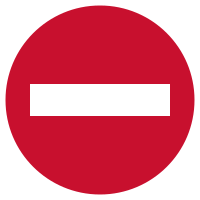
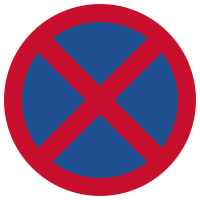
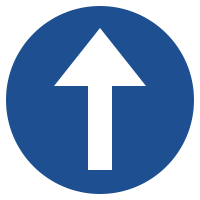
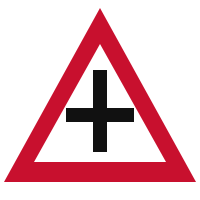
UK signs follow a simple pattern: circles give orders (red rings say what's not allowed, blue circles say what you must do), triangles warn of hazards, and rectangles give information.

Practice quiz
Pick an answer to see whether you're right and why.
Official sources
- The Highway Code (GOV.UK). The full, current rules.
- GOV.UK: speed limits. National limits for every vehicle type.
- Know Your Traffic Signs. The official guide to UK road signs.
- nidirect: motoring. Rules and licensing in Northern Ireland.